

How Do We Rebuild Trust?
From the inside out.

Recently, I was invited onto a podcast as an “expert” on trust. The YES came fast—whole-bodied, electric, tinged with that perfect edge of fear.
I trusted the response.
But in the days that followed, I fell into a familiar pattern: googling wisdom nuggets, capturing others’ insights on my phone, trying to become worthy of an invitation I’d already received.
It was doubt, dressed up as preparation.
The morning of the interview, I woke up groggy, contracted, untethered. I couldn’t muster the discipline to sit or sweat—the things that reliably bring my mind and body to the same place. I picked a senseless fight with my husband. All before 8am.
By the time I clicked into the Zoom room, I felt split — and like a total imposter.
A younger version of me would have revved the engine. Proving myself. Performing myself. But that morning, something else came through.
I welcomed the whole messy racket, but didn’t let it drive. Felt the wobble, trusted the anchor. Spoke from what felt true, not what sounded polished. Chose tired presence over fake enthusiasm.
My ragged, irritable, unrehearsed self wasn’t a problem. It was a portal.
What unfolded felt like magic.
The conversation wasn’t about trust. It was trust.
It turns out, the how is the what.
Everywhere we look, trust is fraying. Institutions teetering. Democracies thinning. Even the videos we watch, and headlines we read carry a low hum of suspicion: Is this even real?
I heard a futurist say we should expect a century’s worth of change in the next ten years. Imagine 1926 to now — from telegrams to TikTok, steamships to space travel, slide rules to superintellegence. All that, again, before 2036.
Of course we’re disoriented. And somewhere inside the dizzying swirl, an existential question rises:
What’s worthy of our trust now?
Here’s what I’m sensing: ours isn’t just a crisis of trust. It’s a crisis of trusting the wrong things.
Modernity has trained us to trust what’s legible, not what’s alive. The map over the territory. The performance over the pulse. The symbol over the substance. The book over the bird.
We trust what’s quick to assess — metrics, titles, credentials. Not because they’re the whole truth, but because the fast work of sorting is easier than the slow work of discerning.
We trust authority: whoever’s in charge, even if they’re out of integrity.
We trust confidence: the smooth pitch, the AI that answers instantly, confidently, wrongly.
We trust certainty: five-year plans, linear paths, predictions about what we can’t possibly know.
But certainty without humility isn’t trust. It’s control. And control is what we reach for when trust feels too risky.
Real trust begins where certainty ends.
So where do we start?
With a U-turn. Trust is an inside job.
Before asking what’s trustworthy out there, the first question is: Do I trust myself?
Most of us don’t. We’ve outsourced trust so completely the muscle has atrophied. We poll friends before checking in with ourselves. We ask the algorithm what we want before asking our own hearts.
And the conditioning starts early. School trains us to trust the person at the front of the room. The test score. The essay written for someone else’s approval. We’re taught to override our inner knowing before we even know it’s there.
If I don't know what's trustworthy within me—my body's knowing, my felt sense of truth—how can I recognize what's trustworthy beyond me?
So I practice. Slowly. Repetitively. Like gathering honey.
I spend time each day in what one of my teachers calls “a realm deeper than thought.” I pause before reacting. I follow the clues I’ve left for my future self: say yes to sunsets, cold water, time on my cushion before touching my inbox.
And when I get still enough, something shifts.
A trustworthy kind of attention returns.
As the noise recedes, what I can trust becomes clear:
Silence. Space. Simplicity. Synchronicity.
The pull, not the push.
The expansion, not the contraction.
The must, not the should.
The ocean, not the waves.
If I can be here now, I can be there then.
Trust is fractal. It begins within us, echoes between us, and ripples far beyond what we’ll ever see.
The more I trust myself—not to be perfect, but to be present—the more trustworthy I become. Not because I’m right or certain, but because I’m whole.
And the people I trust most? They’re the most fully themselves. Undefended. Transparent. A shimmering coherence between inner and outer.
Trust is contagious. By trusting myself, I give others quiet permission to do the same. And when I loosen my grip, everyone gets more space to breathe — and fly.
Trusting myself also helps me trust the unfolding. The current beneath the chaos. The tide that always turns. The quiet pulse of spirit reminding me we’re held by something larger than what’s breaking. That things must break apart before they break through.
Trust is precious, but it’s not scarce. When we scan for the good, it’s everywhere. Leaders calling the emperor naked. Artists holding up mirrors. Poets naming the ache. Helpers showing up — bruised, but intact.
Einstein called it humanity’s most important question: Do we believe the universe is friendly?
Despite everything that tries to convince me otherwise, I do. And lucky for us, it’s patient enough for us to remember.
Repairing trust isn’t a someday side project.
It’s a species-level survival skill— the one that moves us from fear to flourishing.
Starting now.
Feeling trustworthy right now:
My interview with We Are For Good — where this reflection on trust began
Melinda French Gates — grace and presence in the midst of everything
Sarah Jones’s new show: America, Who Hurt You? — creative genius and the truth-telling we need now
A few updates:
The Flight School Fellowship — I’m thrilled to announce applications will open February 15. We’re looking for emerging adults worldwide seeking what school left out — a year to pause, look up, and discover what really matters. Check out our student-led Instagram, and stay tuned for application details…..
What’s the point of school now? If you’re in the Bay Area, my friend George Lee and I are hosting a conversation at Manny’s on February 24. We’d love to see you there!
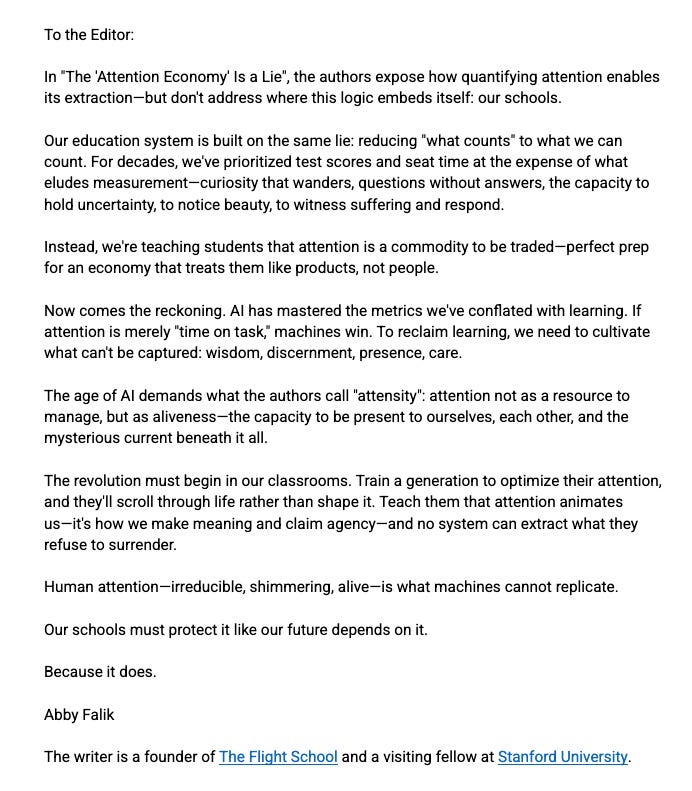
Are we losing our minds? Many of you reached out after my essay on our attention crisis. In that spirit, here’s my recent letter to The New York Times on why the attention revolution must begin in our classrooms. They didn’t publish it, but it feels too important not to share:
“Trust is fractal.” 💯
Once I understood trust as the ability to believe I can deal with whatever happens, I gained the ability to navigate toward freedom. It's a beautiful essay, Abby. Thanks for sharing yourself in the world.