

Why do you walk so fast?
On speed, slowness, and our freedom to choose.

Abby, why do you always walk so fast?”
Carlitos, my seven-year-old host cousin, is trailing me as we cross his family’s field to harvest rice. It’s July 1996—the summer before my senior year of high school. I’ve come to Ometepe, a volcanic island in Lake Nicaragua, in search of an experience that will stretch me and, if I’m honest, shape my college applications.
I’m like a toddler here—needing help with the outhouse, learning which plants sting and which ants bite. It’s exhausting, trying so hard to squeeze learning from every interaction, like there’s a scorecard at the end. I feel like the protagonist in my own movie, but no one else is watching.
Body slogging up the hill, mind racing. Carlitos’ question breaks my stride.
Why do you walk so fast? He yells again, louder this time.
His curiosity is my confrontation. For the first time, I consider it. I walk fast because…..there's somewhere to go. Because my muscles and mind have been trained to see slowing as weakness and speed as virtue. Because I grew up in a culture that says if I stop moving, I'll fall behind.
Large jewels of rain begin to fall. Sounds soften. My vision blurs. And for the first time in months—maybe years—the whirr of my inner engine slows, then stops. Something lets go. The Abby I’ve been for sixteen years—doing, striving, achieving—dissolves.
What’s left: Being here. Drenched. Delighted. Alive.
Is this what I’ve been chasing all along?
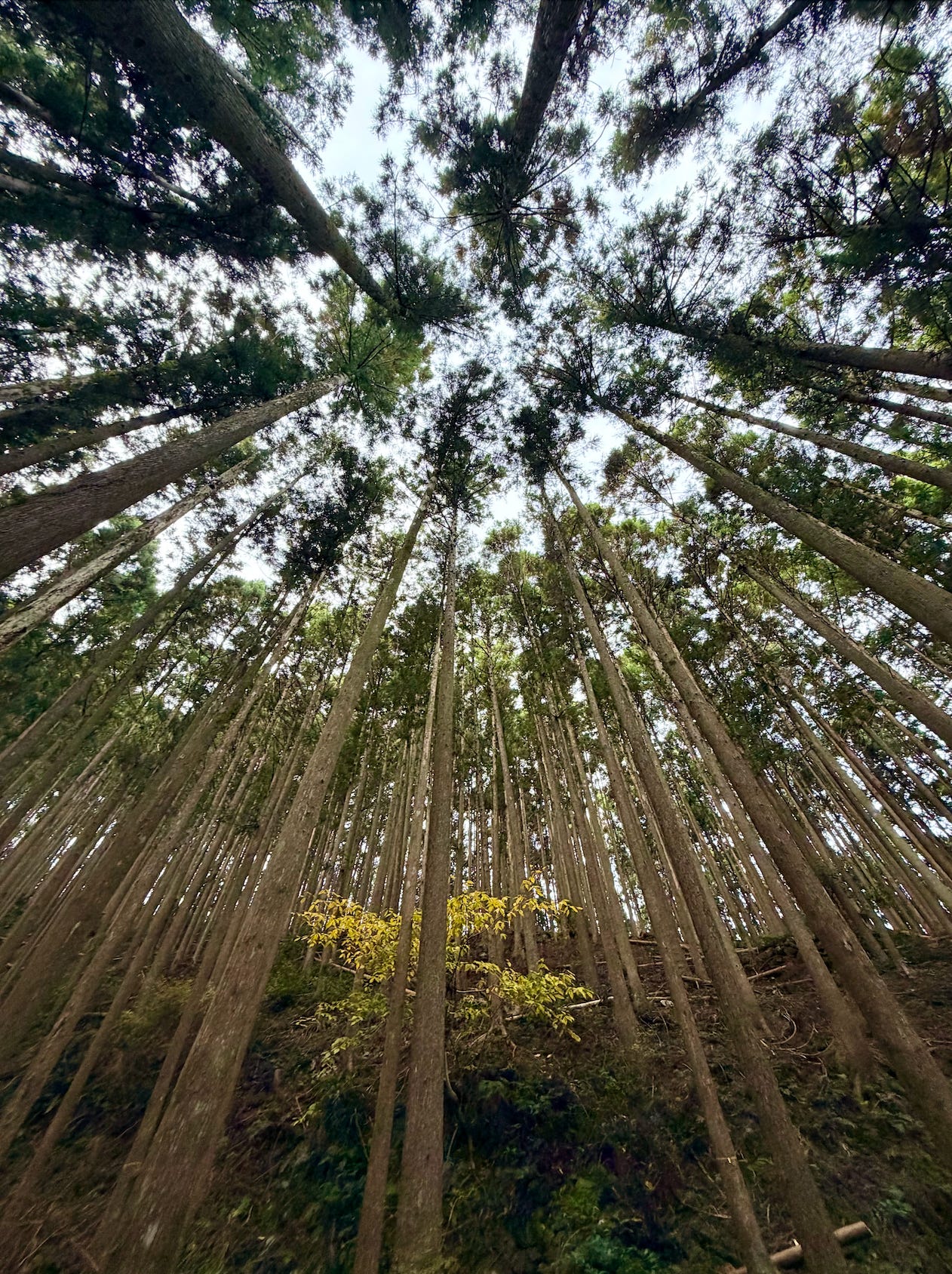
Thirty years later, I’m on another pilgrimage—walking the Kumano Kodo through the forests of Japan. There are dozens of us from around the world, brought together by something we couldn’t quite name.
One morning, we set out for the longest stretch. I trailed Kotaro, our leader, most of the day—savoring the solitude, willing myself onward, one foot after the next. Every so often, his conch shell would sound, a low, resonant call reminding us we were together, even while walking alone.
I was first to finish.
As we waited for the others, Kotaro told me he’d once spent six months by himself in the Himalayas. I asked what he’d learned. He didn’t hesitate: “That I wasn’t ready for the Himalayas.”
That evening, we circled up to reflect. I shared what moved me: wind animating leaves, sunlight streaming through cedars, glimpses of the sacred in silence. But others — who’d struggled on the ascent, who’d needed help, held each other up, navigated the trail in a dance of mutual care—spoke of vulnerability, intimacy, connection I’d walked right past.
With a pang, I realized: I was still walking fast.
Fixated on what I might get from the day, I’d barely considered what I might give, let go of, or leave behind.
My days in Japan worked on me more like tea than food coloring—a gentle whiff that shifts everything, not the dramatic rearrangement I come to expect from immersive experiences.
I joined a yoga class. In one hour: one breath, one hold and one posture — mountain pose. “The initial pose matters more than the final one,” our teacher said with the wisdom of a playful trickster. Lying in savasana, I was struck by what modernity has done to yoga—the muscle, the metrics, the more-more-more. Here, we’d returned to a singular instruction: practice letting go.
A quarter century practicing yoga and here I was, beginning again.
We stayed in monasteries where we changed shoes at every threshold. The slippers had no grip and kept sliding off my feet. For a week, I fought with them mightily. On the last day, my friend Luna suggested: “They might work better if you slow down.”
It wasn’t the slippers. It was my walking.
The whole culture communicated at frequencies I had to slow down to sense: the simplicity of two flowers in a vase, the precise artistry of the bento box, objects arranged with such care that “more” suddenly revealed itself as less.
The lessons weren’t subtle – subtly was the lesson.
Here’s what I’m learning.
Speed is not a virtue. But neither is slowness. The real practice is choosing our pace in a world that would happily choose it for us.
Sometimes the right speed is instantaneous. The invitation to Japan came from a friend I trust deeply. I didn’t ask for details. The answer was immediate: yes. The speed of trust, it turns out, moves faster than thought.
Other times, the most skillful speed requires what Mary Oliver called “the patience of vegetables and saints.” There’s writing that emerges in a single exhale, and ideas that need months, or years, to ripen. Days when I do ten things in an hour, others when I do one thing in ten.
Sometimes, when I’m running late, I play an inner game: Can I move quickly without rushing? The grip loosens. Breath returns. A possibility cracks open and I’m more likely to arrive present, whether or not I’m on time.
Modern life doesn’t ask our permission. It sets the pace and calls it progress. It can feel like running on a treadmill already in motion—always moving, never arriving—where exhaustion masquerades as ambition and keeping up passes for success.
Choosing our pace is how we interrupt that spell. It’s how we notice the exits we were never told existed: a beat before reacting, a season of rest, a longer pause that reroutes us completely.
Each time we break pace with what’s habitual, expected, or rewarded, we make a small refusal. A refusal to be passengers in our own lives. These choices are subtle. Easy to miss. Easy to dismiss. And over time, they determine who—and what—we become.
Thirty years after Carlitos asked why I walk so fast, I’m still carrying his question. But now it feels less personal, more collective:
What is all this speed protecting?
And what pace makes room for what’s trying to emerge?
The choice is always ours—to move at the speed of what’s automatic, or the speed of what’s alive.
What we choose shapes everything.
While I was walking in Japan, a group of Flight School students gathered in Brazil for their first in-person convening— guided by their own questions of pace, presence, and purpose. What might higher education become if we designed it around what matters most? More on what emerged in the new year...
A few things helping me slow my roll:
Resisting — A year ago I installed OneSec, an app that puts a pause between me and any app I choose. That tiny friction—just enough time to ask “Is this really what I want?”—broke my Instagram habit immediately. Sometimes slowing down means adding the smallest interruption to our autopilot.
Reckoning — Daniel Thorson’s essay Deferring the Descent names something I’ve sensed but hadn’t named: “We live in an age of potentially infinite deferral.” Every time discomfort stirs, we deflect with a scroll. He calls it “technologically mediated dissociation”—present enough to function, disconnected from where real transformation happens. Read the full piece—it’ll work on you.
Reflecting — My girl Courtney Martin’s end-of-year questions are always fresh and searching: “What surprised you most about yourself? Who did you love in a new way? What is on hospice inside you? What expectation do you need to lay down?” Grab a pencil and see what emerges!
Relating — A number of you reached out after my post about Aiden Cinnamon Tea (ACT) to let me know it's being retired from ChatGPT in January. Good news: the protocol is available here and it’s easy to import into Claude, Gemini, or other platforms. For those curious about its origins, this conversation between Preeta Bansal and Vanessa Andreotti (one of ACT's creators and author of Hospicing Modernity) explores the work beautifully.
This piece is part of a series, Are we asking the wrong questions? exploring the inquiries that crack us open and help us remember who we really are.
Love this Abby-Thanks for sharing.
A life spent learning and re-learning this. So true and important.